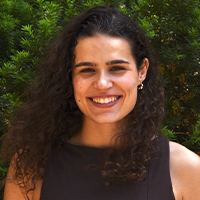
Herma Demissie
- Chemical and Biological Engineering
Herma Demissie is a PhD candidate in Chemical and Biological Engineering in the McCormick School of Engineering, where she works under Professor Julius Lucks to develop accessible diagnostic technologies to address public health challenges in low-resource settings.
Herma’s research addresses the need to balance high technical performance with the unique constraints required for diagnostic deployment in these contexts, including limited infrastructure needs, robustness, modularity and ease of use. To do so, she leverages synthetic biology to engineer a class of naturally occurring biological systems known as CRISPR-Cas to create programmable detection platforms for sensing applications spanning agriculture, water quality, and nutrition, with a particular focus on East Africa. Her work aims to make diagnostics more accurate, portable, resilient to challenging environmental conditions, and usable outside laboratory environments.
Herma’s research combines biosensor engineering approaches with human-centered design and field implementation. She has developed deployable biosensing technologies and led interdisciplinary field studies alongside engineers, biologists, and anthropologists in Kenya to evaluate biosensor technical performance and user adoption. Through her work, she aims to rethink and reshape diagnostic development for resource-constrained settings by centering user feedback and performance evaluation in real-world field conditions.
Herma received a BS in chemical engineering from Columbia University. As an East African national, she is passionate about expanding access to biotechnology innovation, education, and research across sub-Saharan Africa.