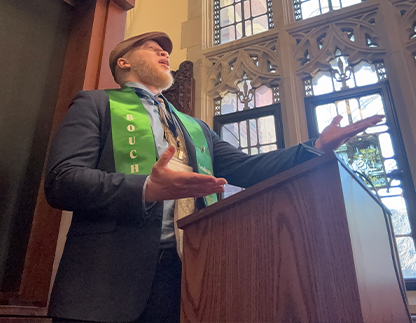
Ozivell Ecford is a PhD candidate in Learning Sciences in the School of Education and Social Policy. His work investigates how interdisciplinary arts and technology can aid trauma recovery, cultivate individual and collective agencies, strengthen community formation, and amplify the voices of historically marginalized and oppressed communities. Ozivell was inducted into the prestigious Edward Alexander Bouchet Graduate Honor Society, which recognizes scholars who demonstrate academic excellence, leadership, character, service, and advocacy.
How would you describe your research and/or work to a non-academic audience?My overarching research examines how interdisciplinary arts can help marginalized communities recover from trauma, develop agencies, and build communities. For me, interdisciplinary arts involve teaching youth about music, theatre, and multimedia design. To that end, parts of my research focus on Human Computer Interaction (HCI), which looks at how humans interact with computers, and now specifically AI. Even more simply stated, I look at how I can use research, art, and tech to help people find and activate their voice.
Tell us what inspired your research and/or work.Inspiration for my work and research comes from my love and desire to be an artist. Before coming to Northwestern, my background was solely in music, theatre, multimedia design, youth development, and community outreach. I was a practicing and working performance artist who also heavily worked with various for-profit and 501(c)(3) arts organizations as a teaching artist
. I worked with organizations like the
Chicago Symphony Orchestra,
Storycatchers Theatre,
Goodman Theatre,
Steppenwolf Theatre,
Old Town School of Folk Music, and more. My work with these organizations usually had a trauma-informed or social justice lens. The work was usually done in the service of incarcerated, justice-involved, court-involved, or underserved youth in underserved communities. I am still a performance artist, and I still work with incarcerated youth as a part of my research.
What is a mistake you have learned from in your career?I've learned that things are not always what they seem. We shouldn't always judge a book by its cover. I used to think that people who were in jail did something to deserve to be there. Almost immediately after beginning to work with incarcerated people, I learned that everyone has a story, and all lived experiences are not equal. Working with incarcerated people, I have encountered the wrongfully accused, people who were just in the wrong place at the wrong time, people set up by their friends and enemies, people who didn't know they were breaking a law, and more. I have met people without homes homeless and abused people who commit petty crimes so that they can have a hot meal and a place to sleep or so they can be in a safe place away from an abuser, and they are the nicest people in the world. As I said, sometimes things are not what they seem.
Whom do you admire in your field and otherwise, and why?I am a fan of organizations like
Kuumba Lynx,
Cities Mentor Project, AMPED at Northwestern University, and Digital Youth Network. I'm into the work of Nichole Pinkard, Megan Bang, Shirin Vissoughi, Maud Hickey, Michael S. Horn, Carol Lee, and more.
What do you find both rewarding and challenging about your research and/or work?I am often working with people who are at their lowest point in life. It can be very hard and disturbing to be around. It can be outright heartbreaking. I live with the fact that I can't help or save everyone. But for those who have a breakthrough through my programs or research, it makes it all worth it. I love hearing them talk about how their story has changed for the better.
What is the biggest potential impact or implication of your work?The biggest potential impact of my work is saving lives. If I have a breakthrough with an individual, it means that I have potentially stopped a murder, a robbery, the sale of drugs, gang violence, or any number of bad decisions that would affect the individuals I work with or their potential victims in the future.
The work and research I do have the potential to positively affect an individual's future orientation, self-identity, and self-preservation, personal growth, and societal interactions.
Why Northwestern?By chance, I took a job in Evanston after the pandemic and ended up working on projects with a variety of Northwestern professors. This resulted in them expressing great interest in my work and pouring into me as mentors. When the opportunity to possibly attend Northwestern as a PhD student was presented
, I was ready to confidently open that door. I walked through and haven't looked back. I've been given an opportunity of a lifetime, and I plan to make the most out of it.
How do you unwind after a long day?I unwind by playing music with my band
, Beta Dogs. Playing my drum set relieves a lot of stress. I train in the martial arts. I'm pursuing my second Black Belt in Shurei Go Ju Ryu Karate. Sparring and punching heavy bags also help relieve stress. I also love watching movies, plays, musicals, and other performance arts.
How would your closest friends describe you?They'd probably say I'm driven, ambitious, and unpredictable.
What did you originally want to be when you grew up?I wanted to be the next Denzel Washington or Kanye West. I wanted to be a famous performer. I was offered record deals on two occasions, once by Universal, but the deals were really bad. Hollywood is just now starting to accept people with Albinism. They were not too open when I was auditioning in the early 2000s.
What advice would you give your younger self or someone considering a similar path?I would say,
“stick to our guns.
” Don't let people project their insecurities on you and gaslight you about your abilities and intellect. The way you see the world is valid and needed.
Tell us about a current achievement or something you're working on that excites you.II was inducted into the Edward Bouchet Graduate Honor Society at Yale and Northwestern University in April 2026. In my PhD journey, I'm one class away from completing all my core course requirements and getting a master's degree in the Learning Sciences. I'm also excited to begin my dissertation prospectus. I was also just invited to potentially work with the SLIPPAGE Lab at Northwestern on an original performance arts project, and I'm in talks with an agent for a memoir regarding Albinism, which I wrote in 2023
. What are you most proud of in your career to date?Since I've been at Northwestern, from peers to professors to the community to conferences, I feel very seen and heard in a way unlike before. I'm growing a solid network. I feel like a good future is certain. I haven't always felt that way.
Published Date: August 4, 2026