Elena González Prieto
- PhD Candidate in the Department of Physics and Astronomy
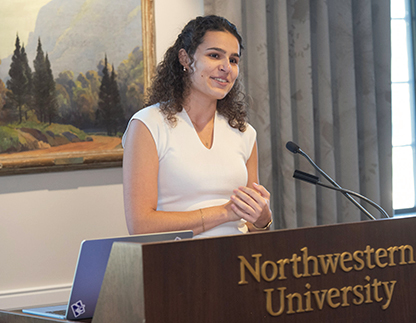
Elena González Prieto is an astronomy PhD candidate in the Department of Physics and Astronomy in the Weinberg College of Arts and Sciences. Her research combines astrophysics and machine learning to investigate intermediate-mass black holes, an elusive class of black holes that may provide the missing link between stellar mass and supermassive black holes. Elena is a 2026 recipient of the Presidential Fellowship and a past recipient of the Northwestern University Data Science Fellowship.
How would you describe your research and/or work to a non-academic audience?
What have been some of the most memorable twists and turns of your career?
The black holes I study are notoriously difficult to detect. When I started my first research project as a summer undergraduate at Northwestern, there were candidates, but no confirmed detections. Toward the end of that summer, rumors began circulating that the Laser Interferometer Gravitational-Wave Observatory (LIGO) had detected the formation of an intermediate-mass black hole through the gravitational waves emitted when two smaller black holes merged. Those smaller black holes also pose a challenge to standard theories of stellar evolution—but that’s a story for another day! The discovery was announced on September 2, 2020, and it was incredibly exciting that the computational simulations I had been working on could explain a possible pathway to its formation!
What is the biggest potential impact or implication of your work?
These black holes may help explain how supermassive black holes formed. These gigantic objects, with masses millions to billions of times the mass of our Sun, sit at the centers of most galaxies, including our own, yet we still don't fully understand how they grew so massive. One possibility is that they began as smaller intermediate-mass black holes, and grew by absorbing surrounding matter, eventually becoming the supermassive black holes we see today. My research investigates where these intermediate-mass black holes form and how they grow, helping us establish a potential missing link between these populations of black holes.
Why Northwestern?
Northwestern is home to CIERA, its Center for Interdisciplinary Exploration and Research in Astrophysics, which provides an incredibly active and collaborative research environment. The research is cutting edge, and CIERA regularly brings experts from across the field, giving me opportunities to learn about new developments, exchange ideas, and connect with researchers working on different problems. Northwestern has also provided excellent resources, from high-performance computing to career development, that have been invaluable throughout my graduate studies. And finally, Chicago is beautiful in the summer!
How do you unwind after a long day?
For the past couple of years, I've taken several wheel-throwing pottery courses at Norris. I've really enjoyed unwinding in the afternoons by, instead, stressing about making bowls! Pottery has taught me to think of “perfection” as a process of making mistakes, learning from them, and trying again. It's a good reminder to understand what went wrong without dwelling on it, and to focus on the next step forward.
What books are on your bedside table?
I’m originally from Spain, so most books on my nightstand are by Spanish authors. I enjoy mystery and crime novels, and I've particularly enjoyed (translated to English here) The Baztán Trilogy by Dolores Redondo and Aquitania by Eva García Sáenz de Urturi. Currently, I’m reading Among the Dead (Entre los muertos) by Mikel Santiago.
What advice would you give your younger self or someone considering a similar path?
One piece of advice I received early on was to always look for opportunities, because you already have the “no.” That encouraged me to apply for summer research internships during my very first year of college, even though I had been told they were highly competitive and rarely accepted first-year students. To my surprise, I was accepted for an internship at Cornell, which gave me an opportunity to gain research experience very early on. I believe that experience opened many doors later in my career.
Tell us about a current achievement or something you're working on that excites you.
I really enjoy developing tools that help us answer fundamental questions in astrophysics. This past year, I developed a machine learning model that predicts what will happen when two stars collide. Our research group is now incorporating the model into large-scale simulations of groups of millions of stars, allowing us to capture the detailed physics of stellar collisions that would otherwise be too computationally expensive to model. This will help us build more realistic simulations and open up exciting new research projects.
Published Date: November 17, 2026